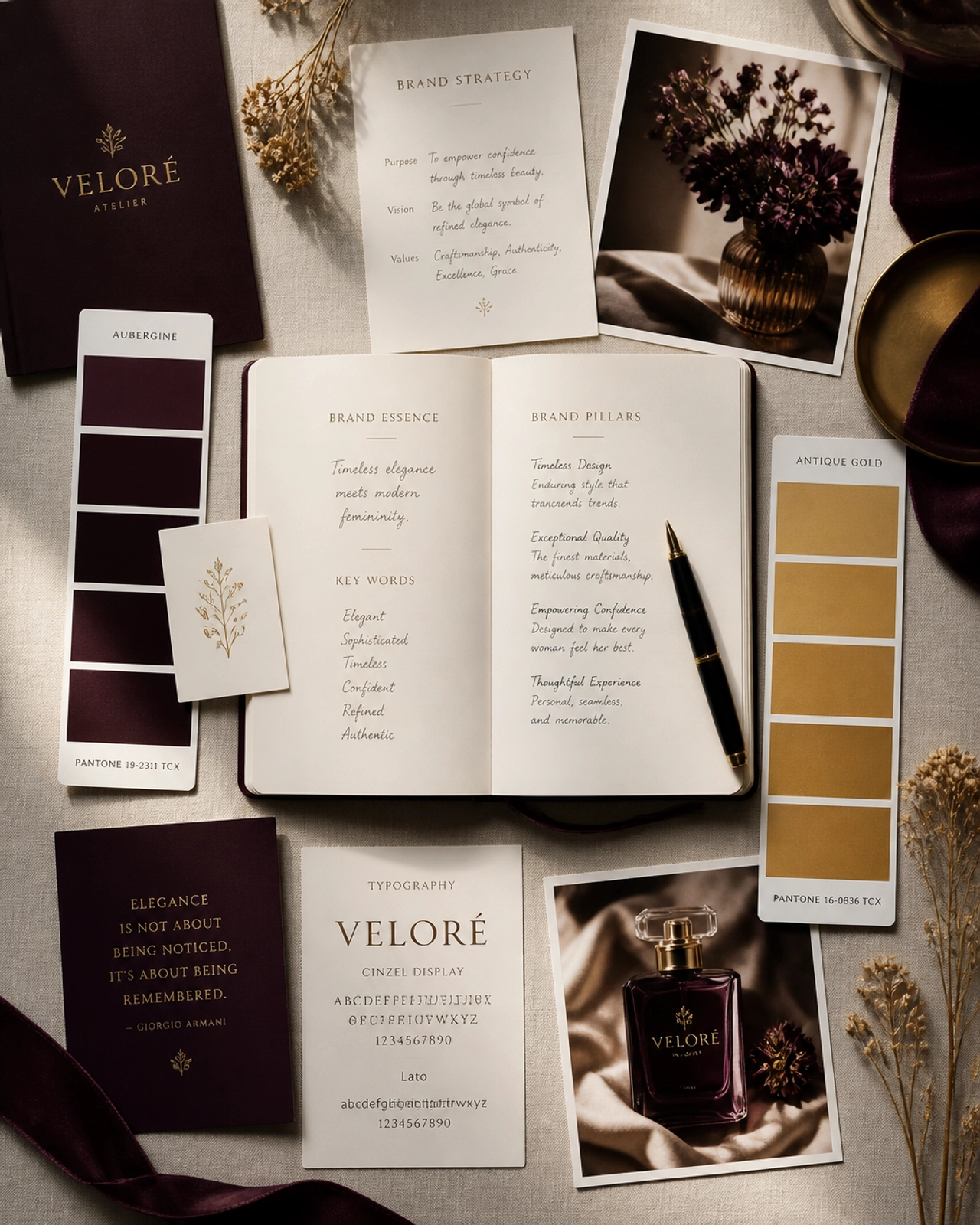
Strategic Brand Identity & Positioning for Founder-Led Service Businesses
If your business has grown past the brand you started with — and marketing feels harder than it should — the problem usually isn’t your marketing. It’s that you’ve never decided, out loud, who you’re the obvious choice for. That’s the work we do here.
Strategic brand identity & positioning, in plain terms
Smart Brand Ideas helps founder-led and women-led service businesses fix the root problem behind hard marketing and price-shopping clients: unclear positioning. We definewho you serve, why you’re the obvious choice, and the exact words that make it land — then connect that strategy to your identity, website, operations, and the AI running behind the scenes. Founded by Andrea Florescu, we’re OMWBE-certified and women-owned, with 25+ years of experience and 389 projects across 6 continents. Explore ourfull servicesor meet the agency.
You’re on a sales call, and honestly? It’s going well. She likes you. You like her. The work she needs is exactly the thing you’re best at. You can already picture the whole project.
Then she asks the question. “So — what makes you different from the other few people I’m talking to?”
And there’s this tiny pause. Half a second where your brain scrambles. You hear yourself start to answer, and it comes out as a list: “Well, I’m really collaborative… I care a lot about results… I’ve been doing this a while…” You can hear how it lands even as you’re saying it. Nice. Capable. Exactly like everyone else she’s talking to.
The call ends warmly. She’s going to “think it over and circle back.” You already know how that one usually goes.
Here’s the part most people miss: that pause wasn’t a sales problem. It was a positioning problem. You couldn’t say what makes you the obvious choice because you’d never actually decided.
For growing service businesses
Who this service is for
This work is for founders whose business has quietly outgrown its brand — and who are ready to charge what they’re worth.
Founders who’ve outgrown their brand
Your work has leveled up. Your brand hasn’t. It still looks like the business you started, not the one you run now.
Experts tired of competing on price
You keep landing in “compared to three other people” conversations — and the deciding factor keeps being cost.
Service businesses ready to scale
You want to hire, delegate, and grow — but everything still runs through you because the brand only makes sense in your head.
Why founders outgrow their brand
When you started, your brand matched your business perfectly — because your business was small and simple. You did a bit of everything for anyone who’d pay. That flexibility was the point.
But you got good. You found the work you love and the clients who value it. Your prices went up. Your standards went up. Quietly, you became a different business — one that helps a specific kind of person get a specific result.
Your brand never got the memo. It still speaks to the beginner version of you, so it attracts the beginner version of your clients: the ones who compare on price, ask for discounts, and don’t quite get what you do. It’s not that your brand is bad. It’s that it’s describing a business you no longer run.
Signs you’ve outgrown your current brand
Read these honestly. If three or more feel familiar, your brand is costing you money you can’t see on any invoice.
You hesitate before sending someone to your website.
Your pricing feels high to say out loud — even when the work is worth it.
You explain what you do differently every single time.
Referrals describe you in ways that don’t quite fit anymore.
You attract price shoppers instead of people who already trust you.
Your marketing feels like shouting into a void that never answers.
What brand strategy is not
A lot of people hear “brand” and picture the decorating: the logo, the colors, the fonts. That’s brand identity, and it matters — but it’s the last 10%. Strategy is the decision underneath it. Skip the decision, and the prettiest logo in the world still can’t tell anyone why to choose you.
A logo, a color palette, or a new font.
A tagline you brainstorm in an afternoon.
A “vibe,” a mood board, or a Pinterest aesthetic.
A one-time project you finish and forget.
What changes after a strong brand strategy?
Nothing magic. Just a business that’s finally easy to say yes to.
You can say who you’re for in one sentence
And the right people nod instead of squinting. Your message stops being a list and starts being a decision.
Premium pricing stops feeling risky
When your positioning is clear, price becomes proof of fit — not a negotiation you dread.
Marketing gets easier and cheaper
You’re no longer paying to make a fuzzy message louder. Every post, page, and pitch pulls in the same direction.
What you’ll leave with
Not a folder of files you never open — a clearer business and the confidence to run it.
Clarity on exactly who you serve and the problem you solve better than anyone.
The confidence to name your price and hold it.
A simple, repeatable way to describe your business that your whole team can use.
A growth roadmap that connects your brand to how the business actually runs.
What happens if you skip brand strategy?
The business doesn’t stop. You keep going — but everything costs a little more than it should. You spend more on ads to get the same trickle of leads. You spend more time on calls that end in “let me think about it.” You spend more energy re-explaining what you do, because your own materials don’t do it for you.
Worst of all, you leave money on the table quietly. A price shopper talks you down. A dream client never calls because your brand didn’t signal that you’re for them. None of it shows up as a single dramatic loss — it just shows up as a business that works twice as hard for the same result.
Strategy isn’t an expense you add on top. It’s the thing that makes everything else — the website, the content, the ads, the sales calls — cost less and work better.
The engagement
What strategic brand positioning includes
Every project is scoped to your goals — but here’s the work that lives inside a positioning engagement.
Buyer research & interviews
We talk to the people who already say yes — and learn the exact words they use to describe the value you bring.
Positioning & messaging
Who you’re the obvious choice for, what you stand for, and the language that makes it land in seconds.
Brand story & voice
A through-line customers remember and repeat — grounded in real business goals, not adjectives.
Visual identity direction
The look, feel, and rules for your identity — designed after the strategy, so it means something.
Operations & systems fit
We connect the brand to how you sell, deliver, and follow up — including the tools and AI running quietly in the background.
A practical rollout plan
Where the new positioning goes first, what to change, and what to leave alone — so nothing stalls.
Our philosophy
We build brands backwards, on purpose. We start with strategy, buyer psychology, and your actual business goals — then design toward them. Branding that only looks good is cute. A brand that helps you sell, hire, and grow is profitable. We build the second kind.
We also speak two languages most agencies don’t speak together: creative and operations. A brand isn’t just how you look — it’s the promise you make and the systems that let you keep it. So we care as much about how you deliver the work as how you present it. And yes, we use AI: quietly, in the background, to move faster and think sharper. The strategy, the voice, and the vision stay human-led.
How we work
Our brand development methodology
01
Strategy, operations & systems first
Before any design, we map who you serve, how the business runs, and where technology and AI can do the heavy lifting. The promise comes before the packaging.
02
Position & define
We decide, out loud, who you’re for and why you’re the clear choice — then write the messaging your whole team can repeat without you in the room.
03
Design the identity
Now the visuals. Logo, type, color, and the rules that keep it consistent — built to carry the strategy, not decorate around it.
04
Roll out & put it to work
We take the new positioning into your website, content, and sales conversations — and give you a plan to keep it consistent as you grow.
Why Smart Brand Ideas leads this work
Plenty of people can make you a logo. Very few connect the brand to how the business actually runs.
We build brands backwards, on purpose
Strategy, buyer psychology, and business goals first. Branding is nice; a brand that helps you sell is profitable. We do the second one.
We speak creative and operations
Most agencies stop at the logo. We connect your brand to how the business actually runs — systems, tools, and the AI working in the background.
Proof, not just polish
OMWBE-certified women-owned, with 25+ years of experience and 389 projects across 6 continents — plus procurement-ready documentation when you need it.
Frequently asked questions
Frequently asked questions about brand strategy
What’s the difference between brand strategy and a logo?
A logo is what your brand looks like. Brand strategy is what your brand means, who it’s for, and why they should choose you. The logo is a small piece that comes after the strategy — and it works far better when the strategy is clear first.
How long does a brand positioning project take?
Most positioning engagements run about four to eight weeks, depending on how much buyer research is involved and how many people need to weigh in. We scope every project to your goals and give you a clear timeline and fixed quote upfront.
Do I have to rename or completely rebrand my business?
Usually not. Repositioning is about getting clear on who you serve and why you’re the right choice — often the name and much of the identity stay. When a bigger change is worth it, we’ll tell you plainly and explain the trade-offs before you decide.
How much does brand strategy and positioning cost?
Brand strategy and positioning projects typically range from about $6,000 to $20,000+, depending on scope, research depth, and how much rollout support you need. You get a fixed quote before we start — and procurement-ready documentation for RFPs when required.
How do I know if I’m actually ready to reposition?
You’re ready when you’re willing to get specific about who you serve — even if that means saying no to some of the work you take today. Repositioning asks for a few honest decisions and a few weeks of focus. If you can commit to that, the rest of the work gets much easier.
Keep building
Related services
Positioning is the foundation. Here’s what it makes possible next.
Ready to position your business for scale? Let’s talk strategy.
If you’re done sounding like everyone else on the sales call, let’s fix the root of it. Tell us where your business is headed — we’ll help you build the brand that gets it there.